
Juz Tabarak Memorization Plan: A Simple Guide for Kids & Adults
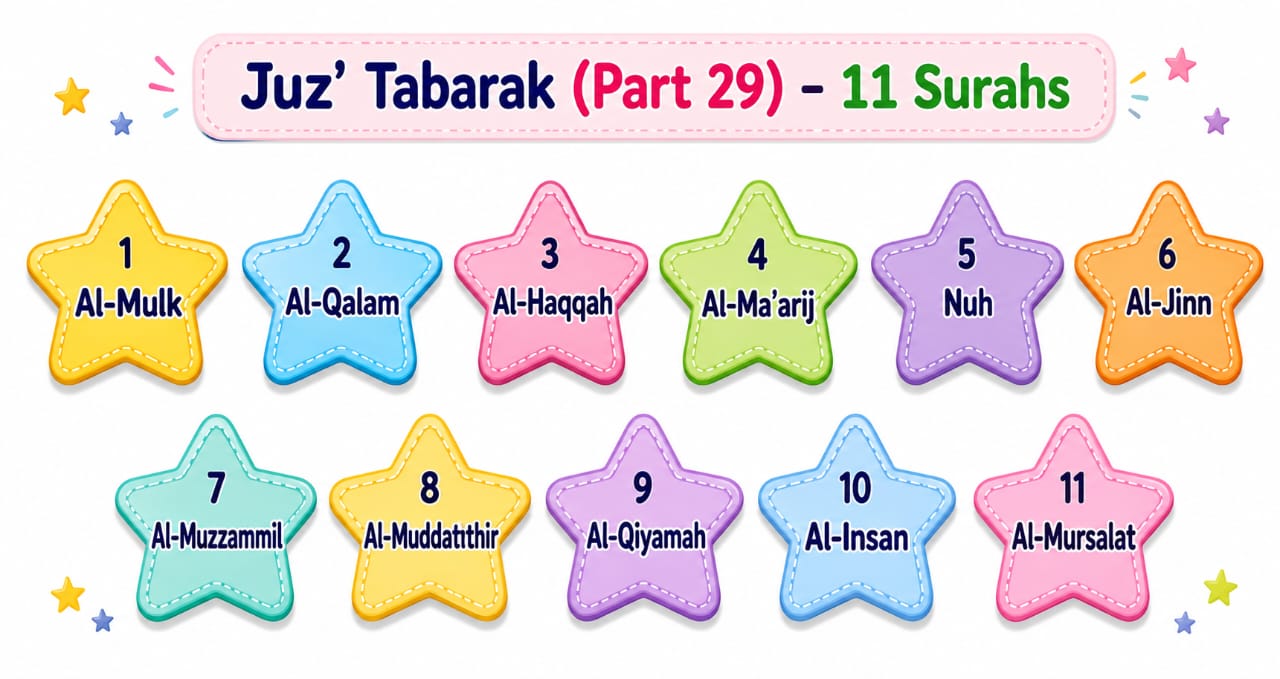
Memorizing Juz Tabarak can be an excellent step in a student's Quran memorization journey. Juz Tabarak is Juz 29 of the Quran and contains a collection of Surahs that can be learned through a structured routine of new memorization, repetition, recitation, and revision.
Whether you are a parent helping your child, an adult beginning Quran memorization, or a student who has already memorized other parts of the Quran, having a clear plan can make the process easier and more consistent.
What Is Juz Tabarak?
Juz Tabarak is the commonly used name for Juz 29 of the Quran. It begins with Surah Al-Mulk and includes a number of Surahs that students can gradually memorize as part of their Quran learning journey.
The Juz is named after the opening word of Surah Al-Mulk: "Tabarak".
For students who are working toward Quran memorization, Juz Tabarak can be approached as a complete memorization goal or as part of a larger Hifz program.
Why Memorize Juz Tabarak?
Memorizing another Juz of the Quran gives students an opportunity to strengthen their memorization habits and improve their regular revision routine.
For many students, memorizing a specific Juz also creates a clear and measurable goal. Instead of thinking about memorizing the entire Quran at once, the student can focus on one Surah at a time and gradually build a larger collection of memorized Quran.
Juz Tabarak can also help students become more familiar with Quranic vocabulary, pronunciation, recitation, and the rhythm of longer passages.
How Many Surahs Are in Juz Tabarak?
Juz Tabarak contains 11 Surahs, beginning with Surah Al-Mulk and ending with Surah Al-Mursalat.
The Surahs vary in length, so students should not necessarily expect to memorize one complete Surah in the same amount of time as another. A shorter Surah may be memorized relatively quickly, while a longer Surah may require more days of practice and revision.
How Long Does It Take to Memorize Juz Tabarak?
There is no single timeline that applies to every student. The amount of time required depends on several factors, including reading ability, age, concentration, previous Quran memorization, daily practice, and revision.
A student who studies consistently may progress faster than a student who practices only occasionally. However, speed should not be the main goal. Accurate memorization and strong retention are more important than rushing to finish.
Some students may choose a short-term goal, while others may prefer to spread Juz Tabarak over several months. Both approaches can work when the plan matches the student's ability and schedule.
A Simple Juz Tabarak Memorization Plan
A good memorization plan should divide the goal into small, manageable steps. Instead of trying to memorize large portions at once, students can work through each Surah gradually.
Step 1: Assess Your Reading Level
Before starting memorization, make sure you can read the Quran correctly. If you are still learning Arabic letters or struggling to connect words while reading, it may be better to strengthen your reading skills first.
Good reading ability can make memorization easier because the student can focus more attention on remembering the verses rather than decoding the words.
If you need help with Quran reading, see our guide: How to Improve Quran Reading .
Step 2: Start With One Surah
Choose one Surah from Juz Tabarak and make it your current memorization goal. Read the Surah carefully and become familiar with its verses before beginning intensive memorization.
Do not worry about finishing the entire Juz immediately. The goal is to build a strong foundation.
Step 3: Divide the Surah Into Small Sections
Divide the Surah into manageable portions. Depending on the student's ability, this could be a few verses at a time or another amount that feels comfortable.
Memorize one section until it becomes strong, then connect it with the next section. This approach can make longer Surahs feel much easier to manage.
Step 4: Repeat the New Verses
Repetition is one of the most important parts of Quran memorization. Read the new verses several times while looking at the Mushaf. Then try to recite them without looking.
If you make a mistake, look at the verse again and repeat the difficult part before continuing.
Step 5: Connect the Sections
After memorizing several small sections, recite them together. This helps prevent the student from memorizing each section separately without being able to connect the verses smoothly.
Step 6: Recite to a Teacher
Reciting your memorization to a qualified Quran teacher can help identify mistakes that you may not notice yourself. A teacher can correct pronunciation, Tajweed, memorization errors, and weak areas.
You can learn more about choosing an online teacher in our guide: How to Choose the Best Online Quran Teacher for Your Child .
A Weekly Juz Tabarak Schedule
Students can organize their week around three main activities: new memorization, revision, and recitation.
- Day 1: Learn a small new section and repeat it several times.
- Day 2: Review the previous section and add new verses.
- Day 3: Review everything learned so far and continue with the next section.
- Day 4: Add new memorization and recite the previous material.
- Day 5: Focus on connecting the sections together.
- Day 6: Review the Surah from beginning to the current memorization point.
- Day 7: Use the day mainly for revision and correcting weak areas.
This is only an example. The schedule should be adjusted according to the student's age, school or work commitments, reading level, and memorization ability.
How Much Should You Memorize Each Day?
There is no universal daily amount for Juz Tabarak memorization. One student may be comfortable memorizing several verses in a session, while another may need to focus on fewer verses and repeat them more often.
Juz Tabarak Memorization for Kids
Children can make excellent progress in Quran memorization when lessons are appropriate for their age and attention span. However, children should not be expected to follow exactly the same routine as adults.
Shorter sessions, repetition, encouragement, and regular teacher feedback can make the experience more enjoyable and productive.
Parents should also avoid comparing their child with other children. Every child has a different learning pace.
For more guidance, read our article: Quran Memorization for Kids .
Juz Tabarak Memorization for Adults
Adults can also memorize Juz Tabarak, even when they have work, family, and other responsibilities. The most important factor is finding a realistic routine.
For example, an adult may choose a fixed time in the morning, evening, or after one of the daily prayers. Having a regular time can make memorization easier to maintain.
Adults should also avoid setting an unrealistic target that creates unnecessary pressure. A consistent small amount can produce meaningful progress over time.
The Importance of Tajweed During Memorization
Memorization should not be separated from correct Quran recitation. When learning a new passage, students should pay attention to pronunciation, letter articulation, elongation, stopping points, and other Tajweed rules appropriate to their level.
Learning Tajweed while memorizing can help prevent mistakes from becoming part of the student's permanent memorization.
If you want to understand the importance of Tajweed, read: What Is Tajweed and Why Is It Important? .
Students who need a structured Tajweed program can also explore our: Online Tajweed Course .
Why Revision Is Essential
Memorizing new Quran is only one part of the process. Revision is what helps protect the material that has already been memorized.
For example, a student may memorize several pages during one week but struggle to remember them a month later if there is no regular revision.
A good routine should therefore include both:
- New memorization
- Recent revision
- Older revision
- Regular recitation to a teacher
The balance between new memorization and revision can change as the student progresses.
What If You Forget a Surah?
Forgetting part of what you memorized does not mean that you have failed. It is normal for memorization to become weaker when material is not reviewed regularly.
When this happens, return to the difficult Surah or passage and review it carefully. You may need to temporarily reduce new memorization until the previous material becomes stronger.
The goal is not to avoid every mistake. The goal is to recognize mistakes, correct them, and continue learning.
Listening Can Support Memorization
Listening to a reliable Quran recitation can support memorization by helping students become familiar with the pronunciation and sequence of verses.
Students can listen before their memorization session, during practice, or while reviewing. However, listening should support active memorization rather than replace reading and recitation practice.
Should You Start With Juz Amma or Juz Tabarak?
Both Juz Amma and Juz Tabarak can be part of a Quran memorization journey. The best starting point depends on the student's current level and goals.
Juz Amma contains many shorter Surahs and is commonly used by beginners. Juz Tabarak can then provide an opportunity to continue building memorization skills and work through a different collection of Surahs.
If your goal is to complete Juz Amma first, see our: One-Year Juz Amma Memorization Plan .
Juz Tabarak and a Complete Quran Memorization Plan
Memorizing Juz Tabarak can also be part of a longer-term Hifz plan. Students who eventually want to memorize the entire Quran can divide the journey into smaller goals.
One Juz can become a milestone. Then another Juz can become the next milestone. This makes a large goal easier to approach and allows students to track their progress over time.
For students interested in structured Quran memorization, explore our: Quran Memorization Course .
Common Mistakes to Avoid
1. Memorizing Too Much Too Quickly
Trying to memorize a large amount every day may feel productive, but it can create a heavy revision burden. Choose a pace that you can maintain.
2. Ignoring Pronunciation
A student should not memorize incorrect pronunciation and plan to fix it later. Mistakes can become difficult to change once they become familiar.
3. Skipping Revision
New memorization should never completely replace revision. Previous material needs regular attention.
4. Comparing Yourself With Others
Every student has a different schedule, ability, and learning speed. Focus on your own progress.
5. Stopping After a Short Break
Missing a few days does not mean you should abandon the entire plan. Simply return to your routine, review what you already know, and continue.
A Simple Daily Routine for Juz Tabarak
A practical daily session could look like this:
- 5–10 minutes: Review older memorization.
- 10–15 minutes: Review yesterday's verses.
- 15–20 minutes: Practice the new section.
- 5–10 minutes: Recite the new section without looking.
- 5 minutes: Note difficult verses for additional revision.
The exact time does not need to be the same for every student. The routine should be adjusted according to age, ability, and available time.
How an Online Quran Teacher Can Help
Learning Juz Tabarak independently is possible, but working with a Quran teacher can provide additional structure and accountability. A teacher can help the student:
- Choose an appropriate memorization amount.
- Correct pronunciation.
- Apply Tajweed rules.
- Listen to daily or weekly memorization.
- Identify weak sections.
- Create a revision routine.
- Track progress over time.
For students who need help with Quran reading before beginning memorization, Noorani Qaida can also provide a structured foundation. Learn more about: Noorani Qaida Online .
Frequently Asked Questions
What is Juz Tabarak?
Juz Tabarak is Juz 29 of the Quran. It begins with Surah Al-Mulk and contains 11 Surahs.
How long does it take to memorize Juz Tabarak?
There is no fixed timeline. The time depends on the student's reading ability, daily practice, previous memorization, age, concentration, and revision routine.
Can children memorize Juz Tabarak?
Yes. Children can memorize Juz Tabarak when the lessons and practice routine are adapted to their age, attention span, and learning level.
How much should I memorize from Juz Tabarak each day?
There is no universal amount. The best amount is one that the student can memorize accurately and revise consistently.
Should I learn Tajweed while memorizing Juz Tabarak?
Yes. Learning Tajweed alongside memorization can help students develop accurate pronunciation and avoid repeating mistakes.
Is revision important when memorizing Juz Tabarak?
Yes. Regular revision is essential for strengthening memorized Surahs and reducing forgetting.
Can adults memorize Juz Tabarak?
Yes. Adults can memorize Juz Tabarak by choosing a realistic routine that fits around work, family, and other responsibilities.
Start Memorizing Juz Tabarak Step by Step
Memorizing Juz Tabarak does not have to feel overwhelming. Start with one Surah, divide it into manageable sections, practice consistently, and review what you have already learned.
Remember that Quran memorization is a long-term journey. Accuracy, consistency, Tajweed, and revision are more important than memorizing as quickly as possible.
Whether you are helping your child memorize Quran or starting your own Hifz journey, a structured plan and qualified teacher can make the process easier to manage.
If you are ready to begin learning Quran online, you can: Book a Free Trial Lesson with Al Shimaa Quran Academy.